Most Camrys from 2012 to 2027 run one of four tire sizes: 205/65R16, 215/55R17, 235/45R18 or 235/40R19. Which one is on your car depends on the trim, not just the year.
That’s why two Camrys from the same model year can need completely different tires. An LE and an XSE parked side by side might not share a single tire size.
And that’s only the factory story. If the wheels have ever been swapped, the size on your car today might not match any chart. So before you buy, let’s pin down what’s actually on your car and what it came with.
How to Find the Tire Size on Your Camry
There are two places to look: the sidewall of the tires on the car right now, and the sticker on the driver’s side door jamb. They answer two different questions.
Start With the Tires on the Car Right Now
If you’re buying replacement tires, the most reliable place to look is the sidewall of the tires currently mounted on your Camry.
Here’s why. Your new tires have to fit the wheels that are on the car today, not the wheels Toyota installed at the factory. And those two aren’t always the same.
The size can change in a couple of common situations:
- You or a previous owner changed the wheels. Say someone swapped the factory 18-inch wheels for 17s, or upgraded an LE from 16s to 19s. The tire size had to change with them. A 235/45R18 simply won’t mount on a 17-inch wheel.
- You bought a used Camry with non-factory wheels. Aftermarket wheels, wheels from a different trim, or a winter setup left on year-round are all common on used cars. The door sticker will still show the original size, but the car may be riding on something else entirely.
In both cases, ordering tires off the door sticker or a chart could get you a set that doesn’t fit your wheels. The sidewall tells you what fits right now.
How to Read the Sidewall
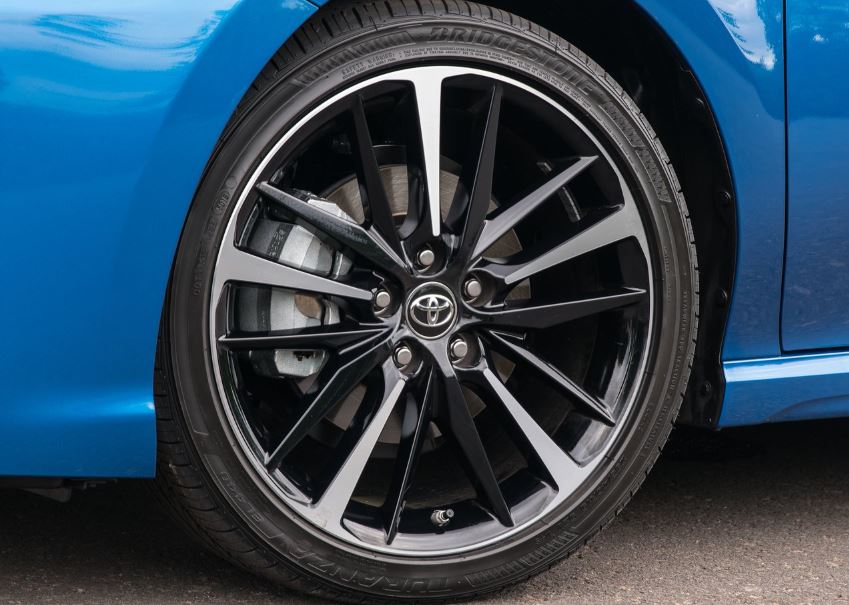
Look for a code that looks something like this: 235/45R18 94V. Here’s what each part means:
- 235: Tire width in millimeters.
- 45: Aspect ratio. The sidewall height is 45% of the width.
- R: Radial construction. Nearly every passenger tire is radial.
- 18: Wheel diameter in inches. This must match your wheel.
- 94: Load index. 94 means each tire can carry up to 1,477 pounds.
- V: Speed rating. V is rated up to 149 mph.
A few tips while you’re down there:
- Check all four tires. On a used car, it’s not unusual to find mismatched sizes or brands. That matters even more on AWD models, which want all four tires matched.
- Check the wheel too. Many wheels have the diameter and width cast or stamped on the back of a spoke or inside the barrel, something like “17×7.5.” That confirms the tire size suits the wheel.
- Look at the DOT date code. The last four digits show the week and year the tire was made. “2423” means the 24th week of 2023. On a used Camry, this tells you how old the rubber really is.
If the tires look like a strange fit for the wheels, such as stretched sidewalls or tires that bulge past the rim, have a tire shop confirm the correct size before you order.
Then Compare It to the Door Jamb Sticker
The sticker on the driver’s side door jamb is called the Tire and Loading Information placard. According to the owner’s manual, it lists the original tire size and the recommended cold tire pressure for your exact car.
That placard is the best record of what Toyota intended. Compare it to your sidewall:
- If they match, you’re on the factory setup. Buy that size and you’re done.
- If they don’t match, someone changed the wheels or tires along the way. Use the sidewall size to buy tires that fit your current wheels. Then use the placard and the charts below to make sure the current setup is reasonable. The overall diameter should stay close to stock, and the load index should be at least as high as the original.
Keep in mind the placard pressure was set for the factory tire size. If your car now runs a different size, ask a tire shop to confirm the right pressure for that size and load index. My Camry tire pressure guide covers pressure in more detail.
Camry OEM Tire Size Chart (2012-2027)
I pulled this together from Toyota spec sheets and owner’s manual data. Trim lineups changed a lot over the years, so I grouped them by generation.
These are factory sizes. If your car has had a wheel swap, go by the sidewall of your current tires instead.
XV50 Generation (2012-2017)
| Years | Trim | Tire Size | Wheel |
|---|---|---|---|
| 2012-2014 | L, LE | 215/60R16 | 16″ |
| 2012-2014 | SE (4-cyl) | 215/55R17 | 17″ |
| 2012-2014 | SE V6 | 225/45R18 | 18″ |
| 2012-2014 | XLE | 215/55R17 | 17″ |
| 2012-2014 | Hybrid LE / XLE | 215/60R16 / 215/55R17 | 16″ / 17″ |
| 2015-2017 | LE | 205/65R16 | 16″ |
| 2015-2017 | SE, XLE (4-cyl) | 215/55R17 | 17″ |
| 2015-2017 | XSE, XLE V6 | 225/45R18 | 18″ |
| 2015-2017 | Hybrid LE | 205/65R16 | 16″ |
| 2015-2017 | Hybrid SE / XLE | 215/55R17 | 17″ |
XV70 Generation (2018-2024)
| Years | Trim | Tire Size | Wheel |
|---|---|---|---|
| 2018-2024 | L, LE | 205/65R16 | 16″ |
| 2020-2024 | LE AWD | 205/65R16 or 215/55R17 | 16″/17″ |
| 2018-2024 | SE, Nightshade | 235/45R18 | 18″ |
| 2018-2024 | XLE | 235/45R18 | 18″ |
| 2018-2024 | XSE | 235/40R19 | 19″ |
| 2020-2023 | TRD (V6) | 235/40R19 | 19″ |
| 2018-2024 | Hybrid LE | 205/65R16 | 16″ |
| 2018-2024 | Hybrid SE / XLE | 235/45R18 | 18″ |
| 2021-2024 | Hybrid XSE | 235/40R19 | 19″ |
XV80 Generation (2025-2027, Hybrid Only)
Since the 2025 redesign, every Camry is a hybrid. It uses Toyota’s fifth-gen hybrid system with the 2.5L four-cylinder and an eCVT, in FWD or electric AWD.
According to the Toyota pressroom, the 2027 Camry carries over from 2026 with the same five grades. Only the pricing changed. So the 2026 and 2027 tire sizes should match.
| Years | Trim | Tire Size | Wheel |
|---|---|---|---|
| 2025-2027 | LE | 205/65R16 | 16″ |
| 2025-2027 | SE | 235/45R18 | 18″ |
| 2026-2027 | Nightshade | 235/45R18 or 235/40R19 | 18″/19″ |
| 2025-2027 | XLE | 235/45R18 | 18″ |
| 2025-2027 | XSE | 235/40R19 | 19″ |
Why the Sizes Matter More Than You’d Think
Here’s a quick bit of math that changes how you look at these sizes. All four common Camry sizes have almost the same overall diameter. What changes is how much rubber sits between your wheel and the road.
| Size | Approx. Overall Diameter | Approx. Sidewall Height |
|---|---|---|
| 205/65R16 | 26.5″ | 5.2″ |
| 215/55R17 | 26.3″ | 4.7″ |
| 235/45R18 | 26.3″ | 4.2″ |
| 235/40R19 | 26.4″ | 3.7″ |
See that? The 16-inch LE tire has about an inch and a half more sidewall than the 19-inch XSE tire.
That extra sidewall acts like a second suspension. It soaks up potholes, expansion joints, and broken pavement before they reach your seat.
The diameters stay within about 1% of each other. That’s why moving between these sizes generally keeps your speedometer and ABS happy. It’s also why a previous owner could swap wheel sizes without the car obviously acting up, and why the sidewall is worth checking on any used Camry.
My Take: Going Off-Spec for Comfort
I’ll be honest. I don’t always run the factory size.
On the Camry I drive on bumpier roads, I go for a tire with more sidewall. Sometimes I even drop the wheel size, like going down to 17-inch wheels, just so I can fit a thicker tire.
The difference in comfort is real, especially on rough pavement. For long road trips, I also find a taller sidewall just feels better. It’s quieter, softer, and less tiring after a few hundred miles.
Toyota’s official position is to use the size on the door placard. That’s the size the car was engineered and tested with. Real-world practice is a little more flexible, as long as you follow a few rules.
The rules I follow when downsizing
- Keep the overall diameter within about 3%. The sizes in the table above already do this.
- Match or beat the load index and speed rating shown on your original tires.
- Check brake caliper clearance first. Not every Camry can fit a smaller wheel. Bigger brakes on some trims, like the XV70 TRD, may block a 17-inch wheel.
- Keep the same bolt pattern and offset. My Camry bolt pattern guide covers that.
- Replace all four tires on AWD models, so tread depth stays matched front to rear.
When the new wheels go on, torque them properly. A torque wrench beats an impact gun every time. The specs are in my Camry lug nut torque guide.
Once you’ve downsized, your door sticker no longer matches your tires. From then on, the sidewall is your go-to reference when it’s time to buy tires again.
The Cost Side: Bigger Wheels Cost More Every Time
This part surprises a lot of SE and XSE owners at their first tire replacement.
Ballpark prices for a decent all-season touring tire look something like this:
- 205/65R16: about $110-$150 per tire
- 215/55R17: about $130-$170 per tire
- 235/45R18: about $160-$220 per tire
- 235/40R19: about $190-$280 per tire
Say you’re an XSE owner and you go through three sets over the life of the car. The gap between 19s and 17s could easily add up to $600-$1,000 or more.
A used set of factory 17-inch Camry wheels often costs a few hundred bucks on local marketplaces. That’s not a bad deal if comfort and tire cost matter more to you than looks.
Low-profile tires also pick up pothole damage more easily. Bent wheels and sidewall bubbles show up more often on 19s than on 16s.
Which Size Makes Sense for You?
- You mostly drive on smooth highways and love the look: Stick with the factory 18s or 19s. They handle crisply and look great.
- Your roads are rough or full of potholes: Consider dropping to 17-inch wheels with 215/55R17 tires if your brakes clear.
- You take lots of road trips: A taller sidewall makes long days easier on your back and ears.
- You live in the snow belt: A dedicated winter set on 16 or 17-inch wheels is cheaper and generally works better in snow.
- You bought a used Camry: Read the sidewall of all four tires before you order anything, then compare it to the door sticker. The car may not be on its factory wheels.
- You’re leasing or still under warranty: Keep the factory size. The new Camry’s basic warranty runs 36 months/36,000 miles, and it’s easier not to give anyone a reason to question a claim.
What I Would Do
If I bought an SE or XSE tomorrow, I’d run the factory tires until they wore out. Then I’d shop for a used set of 17-inch Toyota wheels that clear the brakes and mount 215/55R17 touring tires on them.
I’d keep the original wheels for selling the car later. Before ordering a thing, I’d read the sidewall of the tires on the car and compare it to the door jamb sticker, so I know exactly what I’m working with.
On an LE with 16s? I wouldn’t change a thing. That’s already the comfiest setup Toyota offers.
What size are you running on your Camry, and have you ever downsized your wheels? Drop it in the comments. I’d like to hear how it rides for you.